
We're All Building This Story Together | The Heart
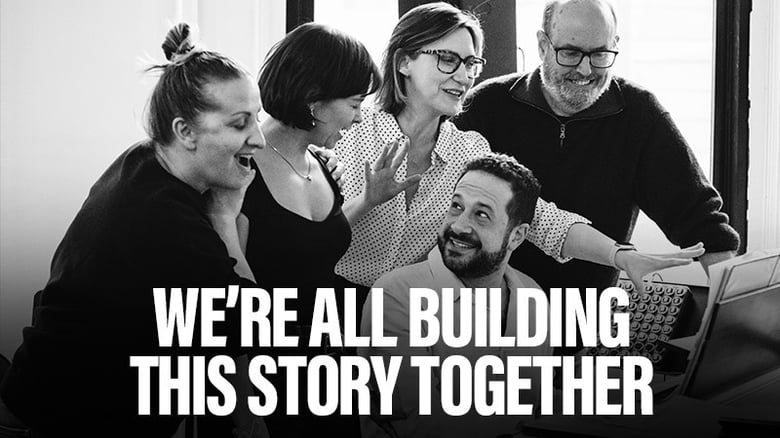
A conversation between The Heart’s writing team (Anne Eisendrath, Ian Eisendrath and Kait Kerrigan) and Director of Artistic Development Gabriel Greene.
GG: What drew you to Maylis de Kerangal’s novel, and how did you imagine it coming to life as a musical?
AE: Our first producers, Stephen and Paula Reynolds, had worked with us on the early development of a project about a heart transplant that ultimately didn’t work out. They generously wanted to continue to support both Ian and me in a project, and we started talking to Kait about some new ideas. After a few conversations, Paula asked for us to meet on zoom – this was all during the pandemic – and she said, “I really think you should go back to the heart transplant.”
KK: To be completely honest, I was really nervous, especially knowing that we were revisiting a topic that they all had a shared history with, but I wasn’t about to turn down a project without trying to find my “in”! I thought about what interested an audience member like me. I wanted to know how it happens – what is the medical process? And I really wanted us to start from new source material. So I googled, like, “medically accurate heart transplant novel, fast-paced, hospital, doctor’s perspective…”
IE: I feel like you also said “not saccharine.” [laughter]
KK: Maylis de Kerangal’s novel was the first thing that came up. All the reviews were like, “This is so medically accurate, it takes place in 24 hours, it follows all these different characters.”
I got excited and I came back to
Anne and Ian and I was like, “I think it’s like A Chorus Line meets a heart transplant!” [laughter] It felt like La Ronde, it had this sense of a relay race. We were all texting each other within the first 50 pages. The novel is so beautifully structured; I don’t think I’ve ever read a book that screamed that it wanted to be a musical more.
IE: Maylis’ novel so beautifully balances heightened poeticism with everyday reality and naturalism. It reminded me of my most cherished experience in the theatre, Come From Away. While the material is wildly different, both pieces share the DNA of uber-theatrical, music- and ensemble-driven storytelling rooted in real-life situations, stakes and events. They also both sound like a potentially terrible idea when you first pitch it! I have a trusted friend in theatre development whose first response to the idea was skepticism and concern, but after he saw the first reading of the piece, he became an incredible champion of the show.
GG: I could see how it presented a challenge; its protagonist – the focus of the journey – is an organ instead of a person. Did that feel like a limitation or a strength?
KK: For me, that felt like a strength from the jump. I love structural challenges and the compression of time; I love the fact that there’s a 24-hour clock and a concentrated place. It’s a very exciting kind of storytelling. The thing we’ve come back to over and over again is that the protagonist is whoever’s keeping the heart beating – that’s what makes it unique and it also makes perfect sense. They all have one job, so whoever has that job at that moment is your protagonist and we’re following that person. During the developmental process, every time we screwed up, it was because we didn’t follow the heart. And it means that you can go deeply into someone’s life for a short amount of time and then you may never see them again. But we care so much about a character when they’re a part of making that heart continue to beat.
GG: Anne, you’ve had an affinity for electronic music dating back to college. Why did that style of music feel like a natural fit for this story?
AE: I have to say, originally, I just wanted to use electronic music because of my deep love for it. It was Ian who said, “But wait, we’re in a hospital so there’s natural beeps and buzzes, there’s a heart that beats like a kick drum, there’s the lush sounds an ocean evokes, the sultry atmosphere of a dance club.” We discovered that electronic music could be a completely organic and warranted choice, and it opened up all kinds of possibilities to play and innovate, to juxtapose technology with nature and raw emotion. I think that’s how most of the music evolved. What if we do this? What if we try this? There was always the desire to push the boundaries, to mix and bend genres.
IE: We’ve often talked about the major shift that has taken place in how we consume music today and how that needs to make its way into the theatre space.
AE: You’ve just jogged my memory – about 10 or 15 years ago, Ian and I were talking to one of our professors from college, an incredible musical theatre historian. He was musing on the future of Broadway and he said to us, “I see these young students coming to my class and they’re listening to music through their earbuds, and so the old musical theatre orchestrations just aren’t hitting them emotionally like they used to.” And that was a light bulb moment for me, because that’s how I feel too. That’s how we consume our music today. We’re walking around with this heavily-produced music coming straight into our ears and it becomes the cinematic soundtrack to our lives; we’re all in our own movies. And so we’ve been thinking about how we can bring that experience into a musical theater piece.
KK: One of the things that sometimes gets leveled at electronica is that there’s a sameness to it. But what’s really beautiful in what you’re bringing to your lush electropop sound is that it’s cinematic and it does have a very dramatic architecture to it. The way the sound builds from scene into song is one of my favorite things about the whole score. It almost never stops – or if it does stop, it’s incredibly intentional.
GG: You have a remarkable ensemble of just nine actors portraying the full scope of people who come into contact with the heart. Are there thematic connections around which roles an actor was given?
KK: That was one of the things that got me so excited about this show. We’ve tried to create character arcs that will be woven by the audience’s connection to the actor – where you see resonances of a character’s journey even in the doubled characters. One of my favorite examples, which came pretty late in the process, is the way we double the actor playing Simon, whose heart drives the show. We only double him a couple times, but when we do, it’s incredibly intentional and I think it’s going to be really moving.
There’s just something really fun about being able to play in that space. I think about it as these people who are telling you the story of this heart that all of them have impacted or been impacted by. They all have the collective goal of telling this story. It creates space for an audience to enter with us and be a part of the storytelling of it. There’s a heartbeat to each of us, which connects us with the actors, and with this story, and builds a sense of community.
IE: Anne and I both have a background in choral and ensemble music. One of the things that really excited us both about telling this story with a nine-person powerhouse cast was the opportunity to mix choral soundscapes with electronica and EDM, which I haven’t really heard before. I also love how these nine actors, all of whom are stars in their own right, seamlessly shift between being a soloist at the center at the narrative to being part of the ensemble fabric. It’s almost a musical representation of interdependence and interconnectivity that the story really speaks to.
GG: Is there anything about this present moment that makes you feel it’s a particularly urgent time to share this story?
IE: For me, it’s a show about choosing life. Every character is using whatever power and agency they have to keep the heart beating. Simon’s parents choose to continue the life of his heart, Claire chooses to accept a new lease on life (with all of the risks and unknowns implicit in that decision), our many medical professionals are constantly taking actions to promote life. For me, this is a story about the utter preciousness of life and the responsibility we each have to live it fully as long as it is ours.
KK: We were talking today with some of the actors about the idea of taking responsibility and choosing to be responsible – choosing to care, choosing to be alive in a way that is accountable. All of that feels essential and blessedly apolitical. And yet, in the moment we’re living through, we lose track of those essentials. I think there’s something simple and deeply human about this story: the sense that we’re all building this story together, and that we’re all impacted by one heart. It’s a show that actively chooses to let you cry, and then cuts it with humor, because that’s what life is. We go back and forth between these moments of life being completely mundane, to being absolutely devastating, to laughing five minutes later. That’s how we survive.
AE: These characters all have specific and unique roles in taking this heart forward to the next level. If at any point one of these characters falls behind in their mission to protect this heart, the show is over and death wins. And it’s a beautiful picture of how we all count, we all matter, and we can all do something to make the world a better place. We all have that ability to create goodness in the world.
Photo credit: The Heart creative team (L-R): Mandy Moore (choreographer), Anne Eisendrath (music and lyrics), Kait Kerrigan (book and additional lyrics), Ian Eisendrath (music and lyrics) and Christopher Ashley (director); photo by Tia Byington.
